Reading time : 11 min
Table of Contents
- Key takeaways
- Global Overview: The 2026 Shift Toward Restricting Social Media for Minors
- Key Drivers: Mental Health, Addiction, and Online Safety
- The Precedent: Australia’s Landmark December 2025 Legislation
- Pioneer Nations: Countries That Have Passed Binding Social Media Bans
- Australia (Under 16 Ban & $49.5M AUD Corporate Fines)
- France (Under 15 Ban Passed July 2026 & High School Phone Rules)
- Western & European Legislative Wave: Proposed Bans in 2026–2027
- United Kingdom: Spring 2027 Ban & AI Chatbot Controls
- Canada: Digital Safety Bill & Compliance Pathways
- Denmark & Austria: Digital Evidence Apps & Under-15 Mandates
- Germany, Spain, Poland, Greece, & Slovenia Draft Legislation
- Asia-Pacific and Middle Eastern Youth Social Media Restrictions
- Indonesia & Malaysia: Age 16 Restrictions & Platform Targets
- Turkey & UAE: Legislative Status and Implementation Timelines
- India: State-Level Consultations and Regulatory Outlook
- How Will Youth Social Media Bans Be Enforced? Age Verification & Tech
- Beyond Self-Declaration: Facial Analysis and Government IDs
- State-Sponsored Solutions: Denmark’s Digital Evidence App
- Corporate Liability: Shifting the Burden to Tech Giants
- Platform Scope: Banned Social Networks vs. Exempted Messaging Apps
- Banned Services: Algorithmic Feeds, Streams, and Public Forums
- Exempted Utilities: End-to-End Messaging & Moderated Youth Hubs
- The Debate: Youth Protection vs. Privacy and Digital Rights
- Supporting Arguments: Tackling Mental Health and Cyberbullying
- Criticisms: Digital Privacy Risks and Marginalization of Youth
- Frequently asked questions
Key takeaways
- Over 15 nations have passed or introduced binding legislation banning social media access for youth under 14 to 16 as of July 2026.
- Australia's pioneering December 2025 law established corporate fines up to $49.5M AUD ($34.4M USD) for platform non-compliance.
- Age verification is shifting from self-declaration to zero-knowledge identity apps, facial age estimation, and digital government IDs.
- Laws explicitly target algorithmic public feeds (TikTok, Instagram, X) while exempting end-to-end messaging utilities (WhatsApp, Signal).
Global Overview: The 2026 Shift Toward Restricting Social Media for Minors
In December 2025, Australia made history by imposing fines of up to $49.5 million AUD on tech platforms allowing users under 16—triggering a global domino effect across more than 15 nations by July 2026. As governments rapidly shift from voluntary industry guidelines to binding legal mandates to combat youth mental health risks, sleep disruption, and online addiction, parents, tech companies, and engineering teams need a concrete operational map of countries moving to ban social media for children.
For years, platform accountability relied on self-regulation and token age checkboxes. Most people get this wrong by assuming these bans are mere political posturing. In production environments, regulators are no longer asking platforms nicely; they are building legal frameworks backed by severe financial penalties. Under 16 social media restrictions have evolved from speculative debate into active compliance mandates enforced across multiple continents.
Key Takeaway: As of mid-2026, over 15 nations have enacted or introduced binding legislation prohibiting children under 14 to 16 from accessing algorithmically driven social platforms, shifting the entire burden of proof onto tech architecture.
Key Drivers: Mental Health, Addiction, and Online Safety
Why are countries starting to ban social media for kids? The legislative shift is propelled by empirical clinical data linking infinite-scroll algorithmic feeds to spike surges in adolescent anxiety, depression, and severe sleep deprivation. This isn’t theory. Pediatric psychiatric registries and public health agencies have classified algorithmic recommendation engines as active public health hazards for developing brains.
Beyond mental health, persistent challenges around cyberbullying, non-consensual image sharing, and predatory grooming have broken political tolerance for passive moderation. Legislative bodies have realized that voluntary parental controls fail when algorithms are explicitly designed to maximize attention capture at any cost.
The Precedent: Australia’s Landmark December 2025 Legislation
Which country was the first to ban social media for children? Australia earned that distinction when its parliament passed federal youth protection legislation in December 2025. The statute established an absolute age cutoff of 16 for account creation across major public feeds, setting off a worldwide push for youth social media ban laws 2026.
Australia’s model established two crucial legal principles: first, zero penalty for minors or parents who bypass restrictions; second, massive corporate liability for platforms that fail to take “reasonable preventative steps.” This structural reframing forced global engineering teams to redesign user onboarding pipelines overnight. The policy ripple effect spread across Europe, North America, and the Asia-Pacific region within months.
Pioneer Nations: Countries That Have Passed Binding Social Media Bans
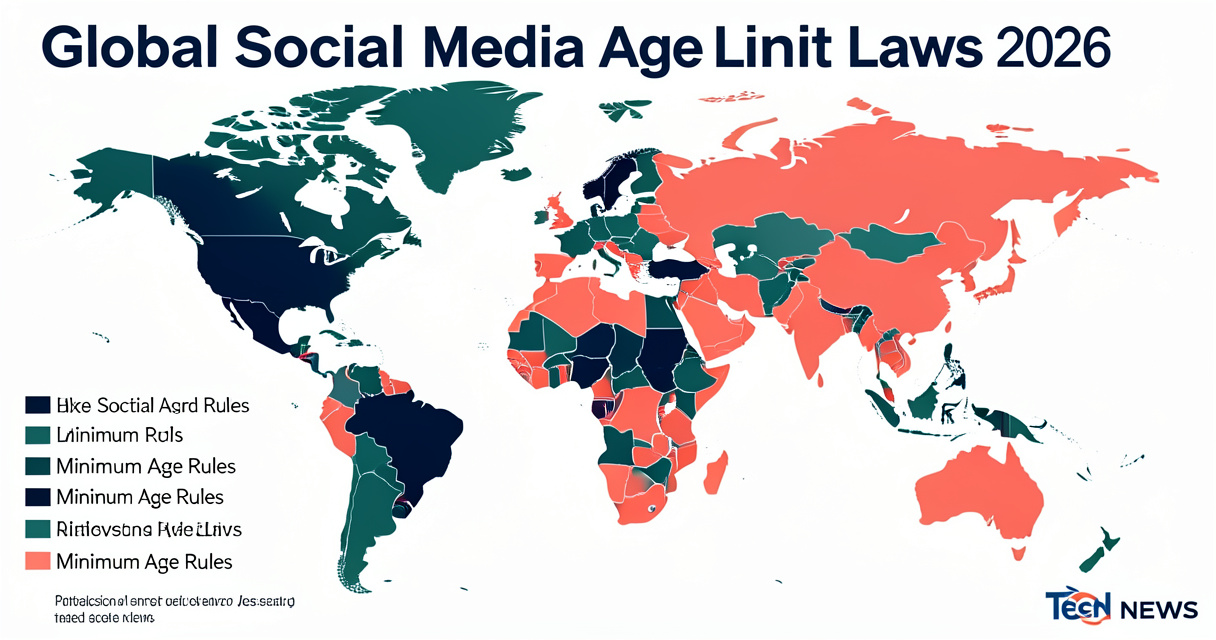
Below is the current legal landscape mapping binding youth social media restrictions across pioneer jurisdictions as of July 2026:
| Country | Minimum Age | Enactment Status | Key Targeted Platforms |
|---|---|---|---|
| Australia | 16 | Enacted (Dec 2025) | TikTok, Instagram, Facebook, Snapchat, X, YouTube, Reddit, Twitch |
| France | 15 | Passed (July 2026) | All public social networks (effective Sept 2026) |
| United Kingdom | 16 | Proposed (Spring 2027) | TikTok, Snapchat, YouTube, Instagram, Facebook, X, AI companion bots |
| Canada | 16 | Bill Introduced (June 2026) | All social media platforms failing safety audit |
| Indonesia | 16 | Announced (March 2026) | YouTube, TikTok, Facebook, Instagram, Threads, X, Roblox |
| Denmark | 15 | Approved (Target Mid-2026) | Algorithmically driven social platforms |
In my years architecting infrastructure at Rebirth Distribution, I’ve seen how API controls and perimeter defenses behave when regulations shift from voluntary guidelines to hard mandates. The demo worked. Production didn’t. Here’s why: legacy authentication flows rely on trusting user inputs, whereas binding legal mandates force engineering teams to verify real identity without creating catastrophic data leakage vectors.
Australia (Under 16 Ban & $49.5M AUD Corporate Fines)
Is social media currently banned for kids in Australia? Yes. According to Australian Government reports, Australia passed the world’s first under-16 social media ban in December 2025 with corporate fines up to $49.5 million AUD ($34.4 million USD) for systemic compliance failure. The law mandates that social platforms strip existing underage accounts and prevent new registrations for youth under 16.
The policy applies directly to popular services including Australia under 16 social media ban targets such as TikTok, Instagram, Snapchat, Reddit, X, and YouTube. Crucially, the Australian model refuses to accept simple self-declared age inputs, putting the burden entirely on backend platform verification infrastructure.
France (Under 15 Ban Passed July 2026 & High School Phone Rules)
What is France’s new law on social media for under 15s? According to the French Parliament, France passed legislation on July 21, 2026 banning social media access for youth under 15, slated to take effect September 1, 2026. This mandate builds upon earlier digital consent frameworks by establishing hard statutory blocks rather than parental override toggles for minors.
Under the new France under 15 social media law, the restriction is paired with a simultaneous nationwide ban on mobile phones inside high schools. French regulators have tied digital compliance directly to educational environments, creating dual digital and physical boundaries to curb adolescent screen dependency during school hours.
| Country | Minimum Age | Enactment Date | Max Corporate Fine | Key Exemptions |
|---|---|---|---|---|
| Australia | 16 | December 2025 | $49.5M AUD ($34.4M USD) | WhatsApp, Signal, YouTube Kids, Google Classroom |
| France | 15 | July 2026 (Eff. Sept 2026) | €750,000 or 1% Global Revenue | Educational wikis, direct messaging utilities |
These pioneer enforcement frameworks prove that statutory age barriers are moving quickly from political debate to active production deployment across Western democracies.
Western & European Legislative Wave: Proposed Bans in 2026–2027
Following pioneer implementations, a massive legislative wave is sweeping across Europe and North America. Parliamentary committees are drafting strict statutory restrictions slated for operational rollout between late 2026 and early 2027.
United Kingdom: Spring 2027 Ban & AI Chatbot Controls
When will the UK ban social media for children under 16? According to the UK Cabinet Office, the UK announced plans on June 15, 2026 to enforce an under-16 social media ban targeted for spring 2027. Under Prime Minister Keir Starmer’s directive, the proposed UK bill extends traditional network boundaries to cover emerging generative AI services.
The upcoming UK social media ban under 16 framework establishes strict 18+ age gates for AI romantic companion chatbots alongside public social networks. British regulators cited severe risks of emotional dependency and unmoderated synthetic interaction as primary drivers for including conversational AI systems in youth protection mandates.
Special Focus on UK Rules: The UK framework explicitly extends beyond traditional social feeds to enforce mandatory 18+ age gating on conversational AI companion bots, recognizing synthetic relationship models as a distinct threat vector to youth psychological safety.
Canada: Digital Safety Bill & Compliance Pathways
What is Canada’s digital safety bill for social media? Canada introduced its updated Digital Safety Bill in June 2026, establishing an age threshold of 16. However, Canadian lawmakers introduced a unique architectural exemption: platforms can sidestep outright statutory bans if they prove through independent third-party audits that their internal algorithmic safety policies and content moderation pipelines completely neutralize addictive design mechanics for minor accounts.
This compliance pathway under the Canada digital safety bill youth ban creates intense pressure for engineering teams to audit feeds, disable infinite scrolling, and remove algorithmic push notifications for young users in order to retain market access.
Denmark & Austria: Digital Evidence Apps & Under-15 Mandates
In Scandinavia and Central Europe, Denmark approved under-15 restrictions scheduled for mid-2026 rollout, anchored by a state-issued “digital evidence” mobile application. Austria has pushed similar legislation setting a strict statutory limit at age 14. Both nations emphasize privacy-preserving cryptographic identity frameworks over centralized database logging.
Germany, Spain, Poland, Greece, & Slovenia Draft Legislation
Across the rest of the European continent, statutory momentum is building rapidly. Spain and Poland have introduced draft legislation targeting an under-16 restriction, while Germany, Greece, and Slovenia are evaluating uniform EU-wide digital age standards. These coordinated efforts demonstrate that countries planning social media bans for minors in 2026 and 2027 represent a unified European policy trend.
As legislative drafts turn into active statutes, regional tech compliance requirements are fragmenting platform architecture across global markets.
Asia-Pacific and Middle Eastern Youth Social Media Restrictions
Youth digital protection mandates are not isolated to Western nations. Across Asia-Pacific and the Middle East, governments are deploying heavy statutory controls to restrict platform access for minors.
Indonesia & Malaysia: Age 16 Restrictions & Platform Targets
Which Asian countries are restricting social media for teenagers? Indonesia announced comprehensive regulations in March 2026 establishing an age cutoff of 16 for public network registrations. Neighboring Malaysia aligned its digital policy shortly after, enacting strict compliance rules for all high-traffic social platforms operating within national borders under the Indonesia social media ban minors policy initiative.
Turkey & UAE: Legislative Status and Implementation Timelines
What are the social media age rules in the UAE? According to UAE Government announcements, the UAE announced an under-15 social media ban in June 2026 with full implementation scheduled within one year. The policy mandates that platforms implement robust age verification tech to prevent underage access across all regional edge servers.
Simultaneously, Turkey passed legislative amendments mandating strict age verification checkpoints for minor users under 15, empowering national telecom authorities to throttle uncompliant platform traffic.
India: State-Level Consultations and Regulatory Outlook
In India, federal ministries and state-level regulatory bodies have launched formal stakeholder consultations. While a nationwide ban remains under debate, state authorities are considering strict digital consent frameworks requiring verifiable parental cryptographic signatures for users under 16.
- Targeted Platforms in Asia: TikTok, Instagram, Threads, X (formerly Twitter), Facebook, Bigo Live, and Roblox.
- Primary Compliance Mandate: Removal of algorithmic recommendation engines for minor profile IDs.
- Regulatory Penalty: ISP-level domain blocking for non-compliant platforms.
These international policies highlight how platform operators must adapt to disparate legal environments across global territories.
How Will Youth Social Media Bans Be Enforced? Age Verification & Tech
Here’s what actually happens in production: when you force platforms to verify identity at scale, simple token validation collapses. Traditional self-declared birthdates are useless under new regulatory regimes. Regulators require verifiable, tamper-resistant proof before granting account access.
Building social media age verification technology that scales reliably while respecting user privacy is the single biggest engineering bottleneck facing tech companies in 2026. That’s not automation — that’s a liability if your system stores raw biometric scans or government identity documents on unencrypted edge nodes.
Beyond Self-Declaration: Facial Analysis and Government IDs
How will social media apps check user ages under new laws? Can social media companies rely on self-declared birthdates? The short answer is no. Platforms are integrating multi-factor verification pipelines, combining real-time facial age estimation algorithms with government ID token validation and banking database checks.
Facial analysis engines estimate age using pixel-level structural analysis, requiring users to submit live video liveness checks to prevent spoofing via static images or deepfakes.
State-Sponsored Solutions: Denmark’s Digital Evidence App
To mitigate privacy concerns, state-sponsored digital identity frameworks are emerging as the preferred architecture in Europe. Denmark’s Digital Evidence App utilizes zero-knowledge identity verification protocol. The app validates user age against sovereign identity databases and passes an encrypted binary true/false token to the requesting platform—without sharing the user’s name, birthdate, or underlying identity record.
Corporate Liability: Shifting the Burden to Tech Giants
What are the fines for tech companies breaking youth social media laws? Regulatory bodies have placed penalties social media companies youth ban failures at historic levels. Fines range from $49.5 million AUD in Australia to 4% of global annual turnover under broader European compliance regimes. By shifting full legal burden onto platforms, governments have made underage account leaks a direct threat to corporate balance sheets.
| Verification Method | Privacy Level | Accuracy Rate | Implementation Challenges |
|---|---|---|---|
| Self-Declaration Checkbox | High | Near Zero (<5%) | Non-compliant; completely rejected by regulators |
| Facial Age Estimation | Medium | High (90-95%) | Demographic bias; spoofing via advanced deepfakes |
| Government ID Scan | Low | Very High (>99%) | High data liability; severe user friction |
| Zero-Knowledge Digital App | Very High | Exact (100%) | Requires national digital ID infrastructure deployment |
Understanding verification mechanics explains why laws distinguish sharply between open public feeds and direct private communication tools.
Platform Scope: Banned Social Networks vs. Exempted Messaging Apps
A critical point of confusion among users and developers involves platform categorization under youth protection statutes. Regulators do not ban the internet; they target specific software architecture models designed for public viral dissemination.
Banned Services: Algorithmic Feeds, Streams, and Public Forums
Which social media apps are banned under youth safety laws? Statutes specifically target platforms featuring algorithmic content streams, endless scrolling mechanics, public profile exposure, and monetized engagement metrics. Platforms caught under full ban scopes include TikTok, Instagram, Snapchat, Facebook, X, Reddit, Twitch, and public broadcast hubs on YouTube.
Exempted Utilities: End-to-End Messaging & Moderated Youth Hubs
Is WhatsApp banned under youth social media laws? Why is YouTube Kids exempt from social media bans? Legislative frameworks explicitly protect utility services. End-to-end encrypted messaging utilities, educational tools, and strictly moderated youth hubs are exempt because their primary function is direct communication rather than algorithmic attention capture.
| Platform Category | Banned Status | Representative Platforms | Legal Justification |
|---|---|---|---|
| Algorithmic Social Networks | Banned | TikTok, Instagram, Snapchat, X, Reddit | High risk of addiction, cyberbullying, and uncurated viral content |
| Live Streaming & Forums | Banned | Twitch, Kick, Public Discord Servers | Real-time unmoderated interaction and broadcast exposure |
| Encrypted Messaging Utilities | Exempt | WhatsApp, Signal, iMessage | Direct 1-to-1 communication utility; no public feed mechanism |
| Educational & Youth Hubs | Exempt | YouTube Kids, Google Classroom, Duolingo | Curated educational content with strict safety controls |
The distinction between utility messaging and engagement-driven feeds sits at the core of ongoing legal and civil rights debates.
The Debate: Youth Protection vs. Privacy and Digital Rights
While youth social media bans enjoy broad support among parents and public health officials, they have sparked intense opposition from civil liberties organizations, privacy advocates, and youth rights groups.
Supporting Arguments: Tackling Mental Health and Cyberbullying
Are social media bans for children effective? Proponents argue that statutory age limits create an essential digital cooling-off period for adolescent psychological development. By eliminating peer pressure to maintain social media presences during vulnerable developmental years, bans drastically reduce rates of online harassment, body dysmorphia, and sleep deprivation.
Criticisms: Digital Privacy Risks and Marginalization of Youth
What do critics say about age verification privacy risks? Digital rights advocates emphasize that enforcing age bans forces millions of adult users to submit sensitive biometric data or government IDs to commercial platforms, creating massive attack surfaces for data breaches and state surveillance.
Amnesty Tech Warnings: Human rights organizations including Amnesty Tech have warned that mandatory age verification threatens anonymity for vulnerable groups, disproportionately marginalizing LGBTQ+ youth who rely on online communities for support when local offline resources are unavailable.
The real cost is: by treating digital spaces purely as hazards rather than learning environments, society risks driving teenagers toward unmonitored darknet forums and encrypted shadows where safety moderation is completely non-existent.
Let me be specific. As nations establish age boundaries and verification systems across global networks, the technology industry faces a fundamental structural transformation. As age verification technology evolves alongside legal challenges from digital rights groups, will government bans successfully safeguard youth mental health, or will tech-savvy teenagers continually find ways around digital borders?
Frequently asked questions
Which country was the first to ban social media for children?
Australia became the world's first nation to pass a binding social media ban for minors under 16 in December 2025. Tech platforms face penalties up to $49.5 million AUD ($34.4 million USD) if they fail to prevent underage account creation.
What is the minimum age to use social media in France?
France enacted legislation on July 21, 2026 setting the legal digital consent age limit at 15. Taking effect September 1, 2026, the law prohibits social platform access for youth under 15 alongside nationwide high school cell phone bans.
Are messaging apps like WhatsApp included in youth social media bans?
No. National youth protection laws explicitly exempt end-to-end encrypted messaging services like WhatsApp and Signal, as well as educational tools and curated hubs like YouTube Kids, because they lack public algorithmic feeds.
When will the UK social media ban for children take effect?
The UK government announced plans in June 2026 to enforce a legal ban for youth under 16 by spring 2027. The proposed framework also mandates 18+ age restrictions for AI romantic companion chatbots.
How will social media platforms verify user age under these laws?
Platforms can no longer rely on self-reported birthdates. Regulators require multi-layered verification, including state-issued digital evidence apps using zero-knowledge proofs, facial age estimation, and government ID checks.
What penalties do social media companies face for non-compliance?
Penalties vary by legal jurisdiction. Australia imposes fines up to $49.5 million AUD ($34.4 million USD), while European frameworks enforce fines reaching up to 4% of a parent company's global annual turnover.